The framework
A deployment framework, not a chatbot bolted onto your stack.
Every engagement is built around the same five principles — the layer between your AI agents and everything they're allowed to do. Five questions, each one something your security or compliance team will actually ask, and each one we answer before anything touches production.
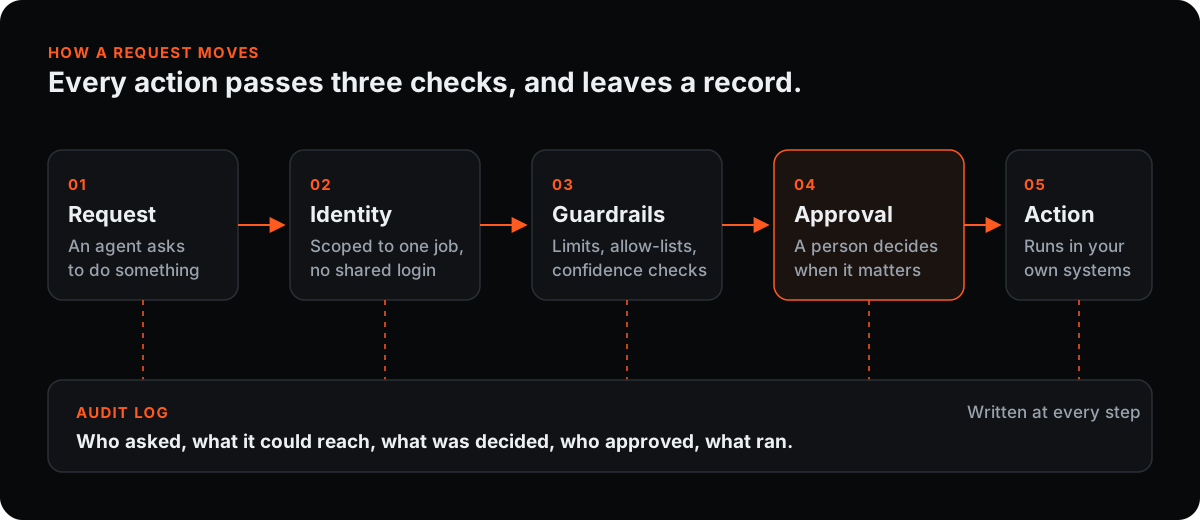
Identity
"Who is this agent, and what is it allowed to do?"
- Every agent is provisioned as its own principal — never a shared API key buried in a script.
- Permissions are scoped to the specific systems and actions a role requires — read-only where read-only is enough.
- Credentials rotate and revoke instantly the moment an agent is retired or a policy changes.
example — agent identity policy
{
  "agent": "invoice-reconciler",
  "scope": ["ledger:read", "ledger:flag"],
  "excluded": ["ledger:delete", "payments:send"],
  "approval_required": ["ledger:flag > $10,000"],
  "expires": "rotates every 24h"
}
example — workflow trace
1. intake-agent   → parsed inbound claim
2. router         → matched to workflow B
3. review-agent   → drafted determination
4. HUMAN CHECKPOINT → approved
5. notify-agent   → sent to claimant
Orchestration
"How do multiple agents and tools work the same task without stepping on each other?"
- Coordinates hand-offs between agents and your existing systems — your CRM, ERP, or case management tool stays the system of record.
- Routes work to a human checkpoint exactly where your policy says one belongs, and resumes automatically once approved.
- Retries and escalates failures instead of silently dropping a task — no work disappears into a queue nobody watches.
Knowledge
"What does the agent actually know, and where does that stop?"
- Grounded in your documents, policies, and systems of record — not general web knowledge with your logo on it.
- Answers are traceable to a source document, so "why did it say that" has a real answer.
- Nothing you feed into your deployment is ever used to train a model — not ours, not any provider's.
example — sourced answer
"Per policy §4.2 (uploaded 2026-03-11),
claims under $5,000 with complete
documentation may be auto-approved."

→ cited from: underwriting-policy-v9.pdf, p.14
example — approval policy
IF action == "send_external_email"
  AND recipient NOT IN approved_domains
THEN require_human_approval()

IF action == "modify_ledger"
  AND amount > threshold
THEN require_human_approval()
Governance
"Who decides what an agent is allowed to do alone?"
- A policy your team writes and owns — thresholds, exceptions, and required approvals, in plain rules.
- Anything outside policy pauses for review instead of executing and asking forgiveness later.
- Scope expands gradually, as the audit trail earns it — not all at once on day one.
Audit
"If something goes wrong, what's the record?"
- Every action, decision, and override is logged with a timestamp and the policy it was checked against.
- Exportable audit trails, built for compliance review and incident response, not just internal debugging.
- Every action an agent takes can be traced back and, where applicable, reversed.
example — audit log
2026-08-14 09:14:02 · invoice-reconciler
  action: flagged invoice #4471
  policy: ledger:flag (in scope)
  reviewed_by: —
  reversible: yes

2026-08-14 09:14:41 · invoice-reconciler
  action: modify_ledger $18,200
  policy: threshold exceeded
  routed_to: J. Alvarez (finance)
  status: pending approval
Comparison
Where this sits versus the alternatives
| Capability | Manual process | Point AI tools | WiseKeel deployment |
|---|---|---|---|
| Scoped agent identity | — | Rare | Standard |
| Human approval gates | Always, everywhere | Usually none | Policy-defined |
| Full audit trail | Inconsistent | Rare | Every action |
| Integrates with existing systems | N/A | Often shallow | Deep, configured for your stack |
| Speed of execution | Slow | Fast | Fast |
Running in production
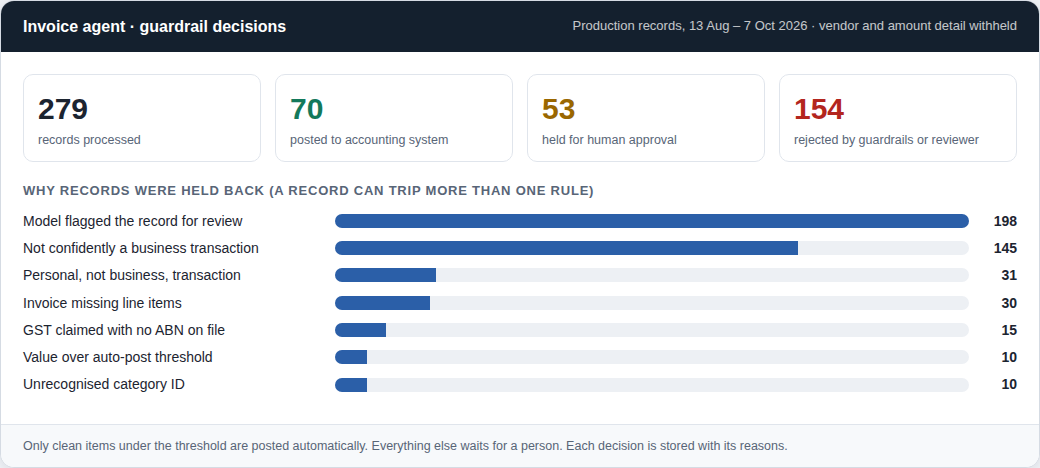
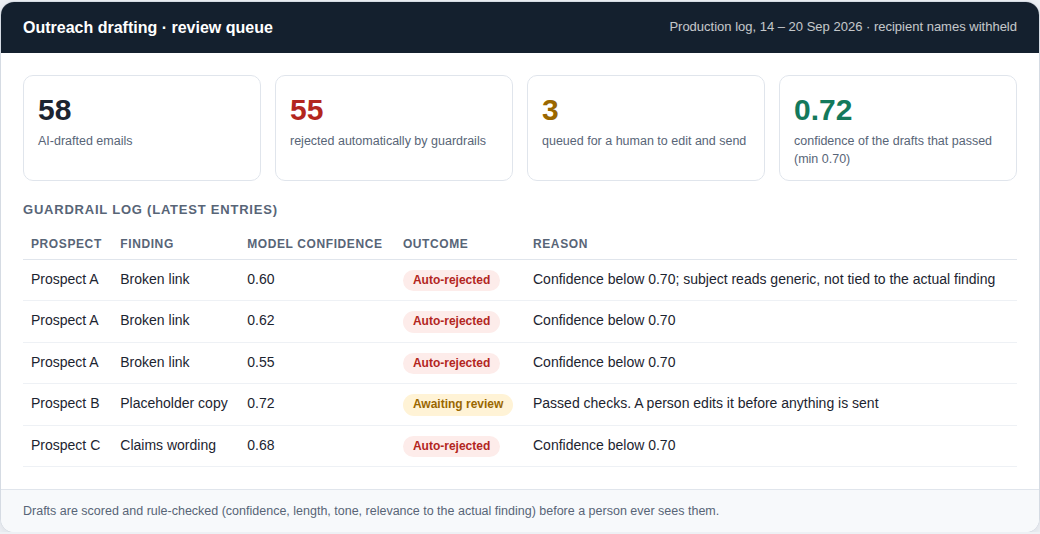
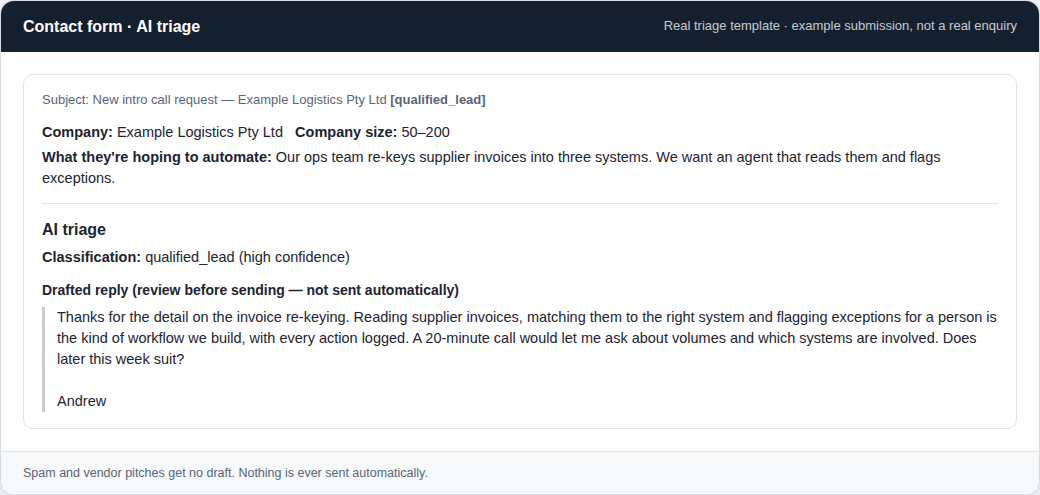
The system we run our own operations on
These are views of agents running our own invoicing, outreach and enquiry handling, not client results. The numbers come from production records; names and amounts are withheld. In each one, the model drafts and the guardrails and a person decide. Read how we run our own operations.